
Hospitals depend on equipment that is expensive, sensitive and hard to replace. When it fails, patients wait. This case shows how a private hospital used IoT to keep its cardiac catheterisation (cath) lab working, and its warranty valid.
Key takeaways
- Imaging equipment must stay at 20–25 °C and 40–60% humidity for the warranty to apply.
- Wireless sensors went in within hours, with no drilling and no lab closure.
- Managers see live conditions and colour-coded history on any laptop or phone.
Why the cath lab
Coronary heart disease is one of the leading causes of death in Sri Lanka. A cath lab diagnoses and treats it, so keeping it running is critical.
The challenge
Sensitive equipment
One of South Asia's well-known private hospitals opened a cath lab with some of the most advanced imaging equipment in the region. It is sensitive to temperature and humidity. If it breaks down, the hospital must prove it was kept within the manufacturer's conditions, 40–60% humidity at 20–25 °C. Otherwise the warranty does not apply and the hospital pays for repairs.
No time to stop
Patients arrive continuously, and for some a day's delay can be critical. Monitoring had to be installed fast, without dust or debris.
The solution
Wireless sensors
To avoid drilling and cabling, KLOUDIP used wireless temperature and humidity sensors. Mounting took hours, not days, so the lab stayed open and no appointments had to move.
HAZER dashboard and reports
A HAZER dashboard shows every sensor in the lab with live values, on any laptop or phone connected to the internet.
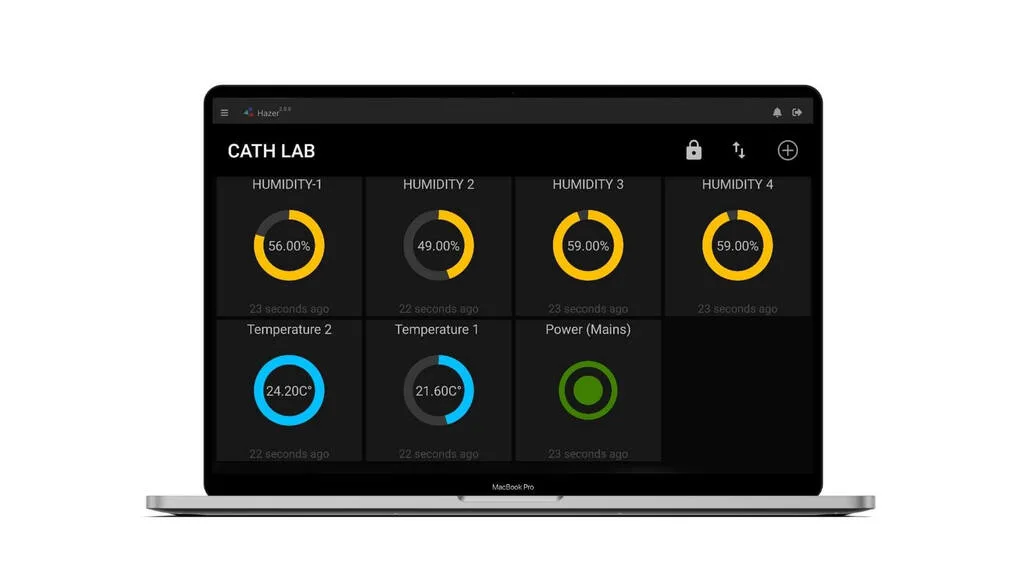
Live cath lab conditions
Reports chart temperature and humidity through the day. The line stays green while conditions are in range and turns red when they are not, so problems are obvious at a glance.
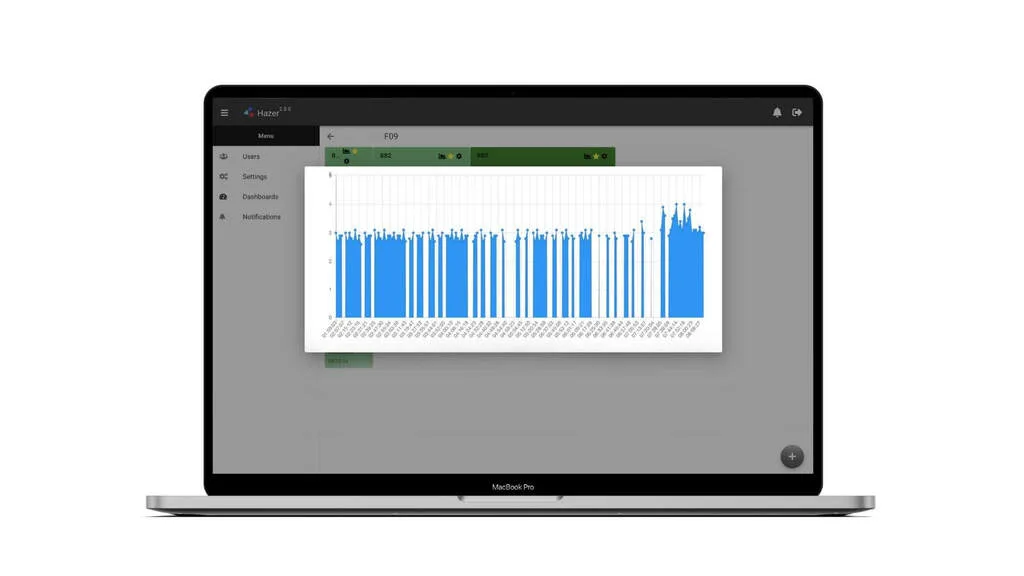
Colour-coded history, ready as warranty evidence
The result
Hospital managers can check the lab from anywhere with a phone, as easily as reading a thermometer at home, while protecting equipment worth millions. They also have a continuous record to show the equipment was kept within its conditions. What works for a private hospital works for public ones too: when budgets are tight, money saved is money earned.
Frequently asked questions
Why monitor temperature and humidity around medical equipment?
Manufacturers set operating conditions. Staying within them prevents breakdowns, and a record proves it if a warranty claim is needed.
Does installation disrupt the hospital?
No. Wireless sensors mount in hours without drilling or cabling.
What else can hospitals monitor?
Medicine and blood storage, cold rooms, power and generators, and staff response times. See our nurse response system case.
Talk to us
Work with sensitive equipment or machinery? We will advise on monitoring it cost-effectively. Contact KLOUDIP
First published on KLOUD LIVE in February 2020. Updated and revised in November 2026.